Click To View Video
Wednesday, November 30, 2011
JNF to host afforestation event at Durban
Jewish National Fund event to focus on adapting forest practices to the effects of climate change in climate summit.
In conjunction with the United Nations Framework Convention on Climate Change currently occurring in Durban, South Africa, the Jewish National Fund will be hosting an official side event on adapting forest practices to the effects of climate change.The program, called “Modifying Afforestation Practices in Adaptation to Climate Change,” will occur on December 3, and will share the techniques of the JNF – and Israel in general – toward keeping forests healthy in semi-arid regions, particularly when the regions encounter disasters such as last year’s Carmel fire.
“Our knowledge is required more and more today because of a desertifying world and water scarcity,” said Dr. Orr Karassin, board member of JNF, leader of the Israeli delegation to Durban and faculty director of the Open University’s sociology and public law departments.
“What we’re trying to do at this conference is share some of this knowledge with other countries, especially with developing countries,” she said.
Many developing countries in the southern hemisphere share Israel’s issues of land dryness, and could benefit from the JNF’s “low-tech” solutions for cultivating forests, as a result of far less deployable hitech strategies, according to Karassin.
Another issue that will be a target point at the event is how to effectively prepare forests for an ever-drying environment that is more and more susceptible to forest fires, she explained. The organization will be presenting a report that it has conducted in the past year following the Carmel fire.
“We are trying to share this knowledge and gain some knowledge from them, especially from the US,” she added.
Allowing for biodiversity and “natural re-growth but with containment,” is key to preserving forests after fires, according to Karassin.
“We’re trying to allow more diversity because we know today that biological diversity, ecological diversity, is a key component to an ecosystem,” she said.
Aside from speaking about the aftermath of fire, the event also intends to address different types of forest maladies that can endanger plant growth.
“Climate change is not only a human health issue but also an ecological issue,” said Karassin.
Source: Jpost.com
Tuesday, November 29, 2011
Revamped Nazareth inn scores international prize for Jewish-Arab duo
The renovation of an abandoned Arab mansion has transformed the Old City from a seedy neighborhood to a mecca for tourists.
A small guesthouse in the Old City of Nazareth, that has been in operation in a converted Arab mansion since 2005, won an award this week at an international tourism fair in London. The Fauzi Azar Inn was accorded top recognition in the category of “best accommodation for local communities” at the Responsible Tourism Awards competition sponsored by Virgin Holidays.This is the first time that an Israeli establishment was in the running for the competition, which accords recognition to what the competition sponsor said are tourist enterprises that are operated “in a way that preserves, respects and benefits destinations and local people.”
Full story via Haaretz
Israeli cabinet approves NIS 265 million program to fight obesity

Click To View Video
On Monday, Israel's socio-economic cabinet unanimously approved an interministerial program to promote a healthy lifestyle in Israel, focused on preventing and reducing obesity. The proposal is expected to come into effect within two weeks.
The plan's numerous recommendations include amending a 1994 law requiring prospective gym members to obtain a physician's approval before signing up; new members would instead be asked to fill out and sign a declaration of fitness.
The program supports lowering the minimum age for working out with free weights, resistance machines and aerobic exercise machines in gyms from age 18 to age 14. It calls for the Ministry of Culture and Sport to expand the general public's access to athletic facilities in educational institutions and other public buildings - including courts, playing fields and auditoriums - when they are not in use by students.
The new plan presents several different approaches for improving the average Israeli's diet. The Ministry of Agriculture and Rural Development will promote the development of hybrid species of fruits and vegetables that are bred for unusually high nutrient density, with very high levels of vitamins, minerals and other micronutrients. The Education Ministry is to see to the enforcement of existing restrictions on selling foods with low nutritive values in school vending machines and cafeterias. The Finance Ministry will be asked to consider expanding the items for which workplaces can claim tax deductions as "refreshments" to include fresh produce as well as the traditional high-fat cakes and sweet or savory pastries.
Another provision in the program would give priority in the state-subsidized "basket" of health goods and services to the introduction of drugs targeting lifestyle diseases. There is also a proposal to restrict television ads for high-calorie foods during peak viewing hours for children.
The estimated cost of the program for the next four years is NIS 265 million, with the lion's share - NIS 153.5 million - coming from the Health Ministry, and the remainder from the ministries of agriculture, education, culture and sport.
Growing forests in the desert
Israeli environmental scientists plant hardy trees meant to
improve air quality and provide renewable fuel, using ‘unusable' land
and water.
Leave it to Israeli scientists to figure out a way of growing trees in the barren sands of the Arava Desert.
The trees aren't just meant to look pretty. This pollution-reducing forest planted over the summer is soaking up harmful excess carbon dioxide from the atmosphere and releasing beneficial oxygen. Another "green" bonus is that the trees are nurtured with recycled sewage water and saltwater.
The project is a research collaboration between Tel Aviv University's Porter School of Environmental Science, the Hebrew University in Jerusalem and the University of Tuscia in Viterbo, Italy. The Italian Ministry for the Environment, Land and Sea is financing the study, which is outlined in an article soon to appear in the European Journal of Plant Science and Biotechnology.
The environmentalists involved are hopeful that the project will not only help reduce humanity's carbon footprint but will also demonstrate how all countries could establish a local plant species on land thought unusable, in order to improve air quality. India, central Asia and Africa in particular have large swaths of such land available, including the vast Sahara Desert.
Once the trees are mature, it's possible that they could become a renewable source of biofuel to reduce dependence on fossil fuels. This is another area of great interest to Israel and just about every other country on the planet.
Finding a hardy species
TAU Life Sciences Prof. Amram Eshel explained that maintaining current forests is not enough to offset harmful human carbon output. Many countries have therefore been converting fertile agricultural lands into forest in an effort to diminish carbon dioxide and increase oxygen in the air.
Photo courtesy of Tel Aviv University
Prof. Amram Eshel with a sample of wood from the Tamarix forest.
The trees aren't just meant to look pretty. This pollution-reducing forest planted over the summer is soaking up harmful excess carbon dioxide from the atmosphere and releasing beneficial oxygen. Another "green" bonus is that the trees are nurtured with recycled sewage water and saltwater.
The project is a research collaboration between Tel Aviv University's Porter School of Environmental Science, the Hebrew University in Jerusalem and the University of Tuscia in Viterbo, Italy. The Italian Ministry for the Environment, Land and Sea is financing the study, which is outlined in an article soon to appear in the European Journal of Plant Science and Biotechnology.
The environmentalists involved are hopeful that the project will not only help reduce humanity's carbon footprint but will also demonstrate how all countries could establish a local plant species on land thought unusable, in order to improve air quality. India, central Asia and Africa in particular have large swaths of such land available, including the vast Sahara Desert.
Once the trees are mature, it's possible that they could become a renewable source of biofuel to reduce dependence on fossil fuels. This is another area of great interest to Israel and just about every other country on the planet.
Finding a hardy species
TAU Life Sciences Prof. Amram Eshel explained that maintaining current forests is not enough to offset harmful human carbon output. Many countries have therefore been converting fertile agricultural lands into forest in an effort to diminish carbon dioxide and increase oxygen in the air.
This new Israeli project is based on the belief that it's much better
to encourage growth on seemingly worthless land with seemingly
worthless water.
"When you take the overall carbon balance of converting agricultural land and freshwater into energy products, you may not gain that much," said Eshel. "You're investing a lot of energy in the process itself, thus releasing a lot of carbon into the atmosphere."
To conserve precious stores of fresh water, the researchers chose to
use low-quality recycled sewage water as well as saltwater that's the
by-product of desalination plants. Then they searched for a plant
species hardy enough to successfully grow in desert conditions.
They settled on Tamarix, a botanical genus that includes salt cedar trees and is indigenous to old-world deserts. In the Arava -- a section of the Great Rift Valley running from the southern end of the Sea of Galilee down past the Dead Sea to the Gulf of Aqaba near Eilat -- they planted 150 different varieties of Tamarix in a common garden setting and also in denser fields the way commercial crops are grown.
Now the researchers are starting the hard work of analyzing the
amount of carbon dioxide the crops have successfully captured from the
atmosphere. If that can be quantified, they will be able to recommend
specific growing guidelines to other countries.
If they can also be used as biofuel, the potential is almost limitless. Until now, growing crops dedicated to fuel production has been controversial, since converting agricultural land could have the side effect of creating food shortages.
Arid and previously unused desert lands provide an ideal solution, Eshel says. Israel doesn't have enough of this land to make a large-scale operation economically feasible, but places like the Sahara Desert could be ideal.
http://www.israel21c.org/environment/growing-forests-in-the-desert
"When you take the overall carbon balance of converting agricultural land and freshwater into energy products, you may not gain that much," said Eshel. "You're investing a lot of energy in the process itself, thus releasing a lot of carbon into the atmosphere."
Photo courtesy of Tel Aviv University
The Tamarix grove in the Arava is soaking up harmful gases from the air.
They settled on Tamarix, a botanical genus that includes salt cedar trees and is indigenous to old-world deserts. In the Arava -- a section of the Great Rift Valley running from the southern end of the Sea of Galilee down past the Dead Sea to the Gulf of Aqaba near Eilat -- they planted 150 different varieties of Tamarix in a common garden setting and also in denser fields the way commercial crops are grown.
Photo courtesy of Tel Aviv University
Flowers of the hardy Tamarix.
If they can also be used as biofuel, the potential is almost limitless. Until now, growing crops dedicated to fuel production has been controversial, since converting agricultural land could have the side effect of creating food shortages.
Arid and previously unused desert lands provide an ideal solution, Eshel says. Israel doesn't have enough of this land to make a large-scale operation economically feasible, but places like the Sahara Desert could be ideal.
http://www.israel21c.org/environment/growing-forests-in-the-desert
Israelis, Germans team up for Lake Victoria

Click To View Video

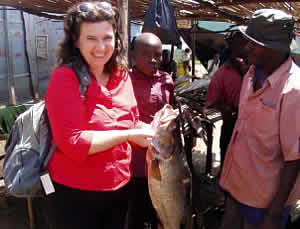
The Foreign Ministry told The Jerusalem Post this week, that a team of Israeli and German experts will be working with Kenyan agricultural and water professionals to upgrade the commercial fishery system and waste water treatment mechanisms within the central African country's Lake Victoria.
Ilan Fluss, director of policy planning and external relations at MASHAV, which is the Foreign Ministry's Agency for International Development Cooperation, said the team made a preliminary visit to Lake Victoria early this month, to assess the needs of the region and strategize ways to better raise tilapia fish (also known as St. Peter's fish) and implement a more effective wastewater treatment system in the lake.
Deputy Foreign Minister Danny Ayalon and German Economic Cooperation and Development Minister Dirk Niebel signed an agreement of consent for the project in January -- as part of a pact the countries had made two years earlier to work together on projects in developing countries.
Facilitated from the Israeli side by MASHAV, the Kenyan project is important to reducing poverty conditions in the Lake Victoria area, Representatives from Germany's GIZ aid agency participated as well as well as Kenyan fisherman and industry professionals.
The German-Israeli team already has a collaboration under way in Ethiopia, and signed an agreement last year to begin one in Ghana.
Can Tel Aviv become a center for fashion?
For Israeli fashionistas, last week’s inaugural Tel Aviv Fashion Week proved what they’ve known for years: Israeli fashion is creative, current and worthy of worldwide attention - and, hopefully, sales.
“I wanted to help my business and help my country,” said organizer Ofir Lev, deputy CEO of the Israel Textile and Fashion Association and a former model. “I wanted to show that there is fashion and creativity in Israel.”
Lev drew on his extensive contacts abroad to bring together foreign fashion writers and Italian star designer Roberto Cavalli in Tel Aviv for the three-day fashion fest.
While the Israeli fashion scene has been around for decades, starting with Lea Gottlieb and her Gottex swimwear empire, it has been many years since there was any kind of public fashion extravaganza.
Lev says he’s already planning another Fashion Week for next April. He’s intent on getting Israeli-American Elie Tahari as well as Ralph Lauren, Calvin Klein, Italian designer Miuccia Prada and fashion luxury house Dolce & Gabbana on board. Everyone is just “two phone calls away,” Lev says.
The challenge is to get everyone to Israel, and the country’s reputation as a dangerous place - albeit undeserved - makes it an uphill fight.
“We have to battle with a Wild West existence,” said designer Dorit Frankfurt, who heads a well-established Israeli label that exports overseas.
For Sasson Kedem, a creator of artsy, architecturally styled pieces for women who also served as a mentor on the one season of “Project Runway Israel,” said Tel Aviv Fashion Week - referred to here as TLV FW, in Fashion TV style - was an opportunity to show the world that “we’re not just about bombs.”
“We’re very clever,” Kedem said, referring to his fellow design colleagues. “But we are different because of this place. We have passion, and we have to grab our opportunities because no one can take our inspiration from us.”
That’s the idea, says Kedem: Israel is not Paris, but Israeli designers excel at “translating the land.”
“You see the Mediterranean in our clothing,” he said. “We do intimate clothing that offers the feel of our country.”
http://www.jpost.com/ArtsAndCulture/Fashion/Article.aspx?ID=247408&R=R1
Click To View Video
Check out the gallery
http://www.flickr.com//photos/isrealli/sets/72157628209274783/show/
Monday, November 28, 2011
Israeli-Palestinian Cooperation Saves Lives

Click To View Video
The Israel Defense Forces on Facebook: http://www.facebook.com/idfonline
The Israel Defense Forces Blog http://idfspokesperson.com
Follow us on Twitter http://www.twitter.com/idfspokesperson
Abdullah Ramal's story reflects a recent trend: security and stability in Judea and Samaria have reinforced cooperation between the Civil Administration and Palestinian people. Five-year-old Ramal crossed into Israel to undergo a life-saving surgery back in September. The Civil Administration of Judea and Samaria donated 380,000 NIS to fully cover Ramal's rigorous dialysis treatments, kidney transplant and medicine.
Read more...http://idfspokesperson.com/2011/11/28/how-israeli-palestinian-cooperation
Subscribe to:
Posts (Atom)